Showing posts with label fly fishing. Show all posts

Wednesday, January 19, 2011

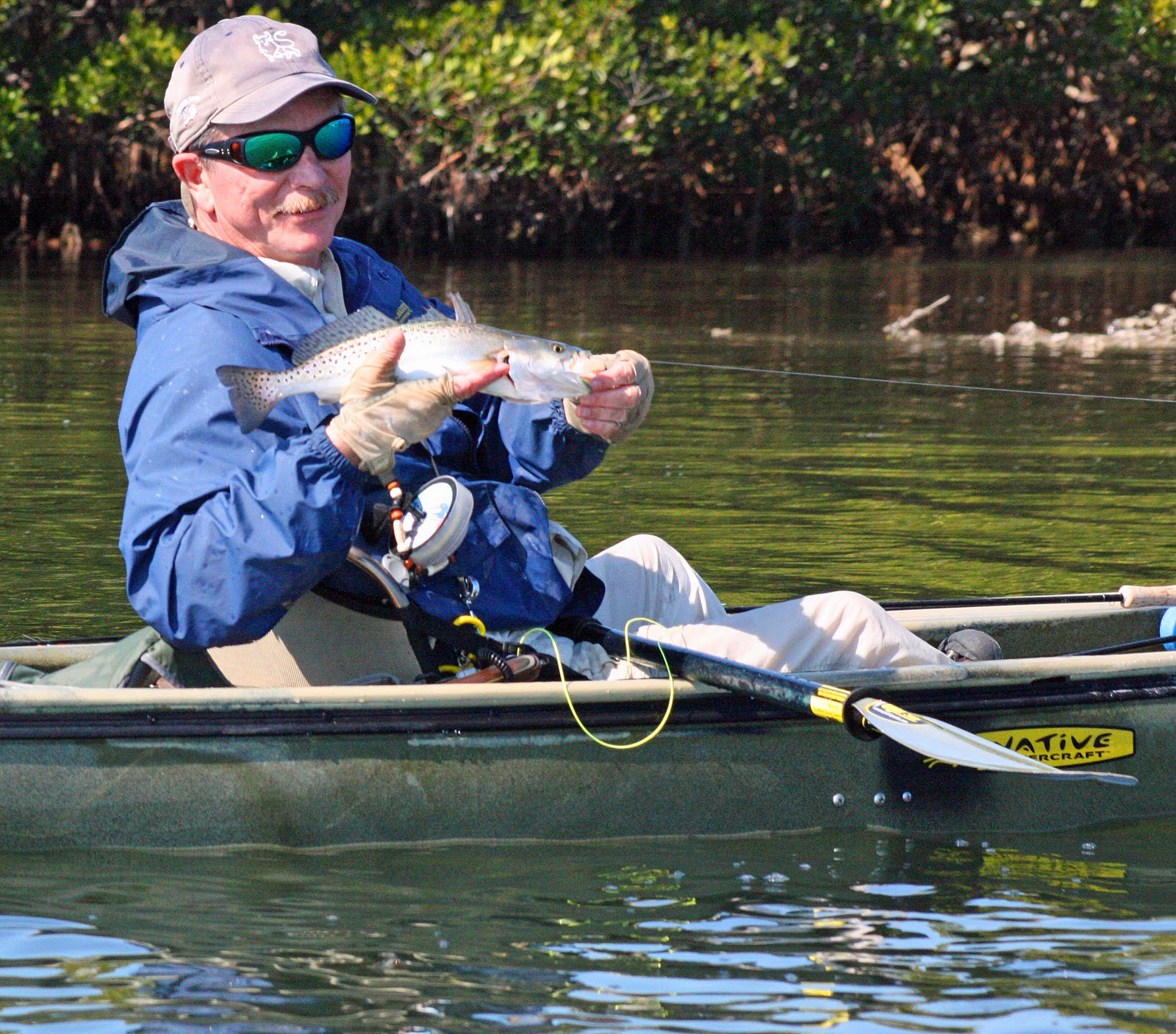
Spotted seatrout have been providing a bulk of the action


John Mallia of Buffalo, N.Y., lands a hefty spotted seatrout on a D.O.A. CAL Jig with gold paddle tail.
Randy Honaker of Centerville, Ohio is a happy fly fisher.
I have been fortunate to have found a bunch of cooperative fish.

For many, fishing has been tough because of cold weather, cold water and wind.

My clients and I have been able to fish a somewhat protected spot and catch a bunch of fish. Over the last six weeks, clients are averaging between 40 and 60 fish per outing, including spotted seatrout to 24 inches, ladyfish, redfish, flounder, sheepshead and sugar trout.

The action has been very consistent and steady.

John Mallia of Buffalo, N.Y., fished with me twice and did well each time. Mallia caught and released plenty of spotted seatrout and a few redfish, flounder and ladyfish. Most of his fish came on a D.O.A. CAL Jig with a gold paddle tail.

Mallia tried the fly rod on one outing and caught 20 spotted seatrout on my Big Eye Baitfish.

Randy Honaker of Centerville, Ohio had an excellent outing. Honaker, an avid fly fisher and excellent caster, managed 40 spotted seatrout to 17 inches on Clouser Deep Minnows.

On another outing, Honaker caught and released a small snook and had several other follow-ups and short strikes and a pleasurable outing on the Myakka River. He was using Clouser Deep Minnows.

Ken Taylor of North Port, Fla., had a very good outing. Taylor, who might be D.O.A. Lures biggest fan, caught and released 75 spotted seatrout on a 1/8-ounce CAL Jig with gold paddle tail, 4-inch D.O.A. jerk worm on a 1/16-ounce jig head and a D.O.A. Shrimp.

I fished the bay on my own one day and had a really good time. It was a day in which the big trout were on a good feed. I managed 80 trout, including 25 of more than 20 inches. The biggest fish was a 25-inch trout. All came on the CAL Jig with gold paddle tail.

I even caught three redfish, including a 25-incher.

The Myakka River is a great place when the weather is bad. It affords us a chance to get out of the wind.

Snook move up coastal rivers during the winter to seek warm water. The Myakka River annually gives up a number of large snook.

We use heavier tackle than normal. We prefer medium-light to medium TFO spinning rods with 25-pound fluorocarbon leaders. We’ll cast D.O.A. 5 1/2-inch jerk worms, CAL Jigs, 4-inch jerk worms and D.O.A. Baitbusters.

Fly anglers won’t want to cast anything lighter than an 8-weight. Sinktip or floating lines work well. Flies of choice include Clouser Deep Minnows, Big Eye Baitfish, Gartside Gurglers and Puglisi patterns.

In addition to snook, we also encounter largemouth bass, Florida gar, tarpon and an occasional redfish and spotted seatrout.

You just never know what might take your lure or fly.

Scenery is quite amazing on the river. The banks are lined with stately oak trees and cabbage palms. Alligators often will sun themselves on the banks during the day.

My schedule is pretty hectic these days. If you’re interested in a trip, please contact me as soon as possible to assure yourself a day (or two).

When the water temperature moves up into the 60s, I look for pompano, bluefish and Spanish mackerel to be plentiful on the deep grass flats of Sarasota Bay. In addition, spotted seatrout, ladyfish, jack crevalle and even gag grouper will be available.

For intrepid anglers, we’ll hit the water before daylight and cast for snook around lighted docks as the weather warms up.

Last time out, I caught a redfish, snook and spotted seatrout (a Saltwater Slam) on fly before dawn.

As always, I would like to thank my generous sponsors: Legacy Paddlesports (Native Watercraft), D.O.A. Lures, Temple Fork Outfitters, Peak Fishing and 7Eye Sunglasses.


Steve Gibson

Southern Drawl Kayak Fishing

www.kayakfishingsarasota.com

http://gibbysfishingblog.blogspot.com/

(941) 284-3406

Sunday, June 20, 2010

Beach snook fishing through the eye of the camera

Here are some photos which chronicle what beach snook fishing is all about. Hope you enjoy!

It's fun fishing. It's fly fishing.
It's baitfish.
Snook. Spotted seatrout. Redfish. Ladyfish. Tarpon.
It's lots of casting.
Some days are great. Some days are slow.
Every trip is wonderful and fun.
Keep your eyes open because you never know what you'll see.
Snook are plentiful, but tough to fool.
The season will run into September, with peak months July and August.
A guided trip with me, Steve Gibson, is $150. You may contact me at (941) 284-3406. I've been doing this for nearly 30 years.

Tuesday, March 2, 2010

Fly fishing is a challenge that keeps on giving

Why fly fish?
Why not?
I posed that question to the late Ad Gilbert and he said, "I've already caught a thousand redfish on spinning tackle. Do I want to catch another thousand on spinning tackle?"
Good point.
Boil that down and it means Gilbert wanted a challenge.
Nothing more.
Fly fishing traces its roots back to 200 AD when Claudius Aelianus wrote about people fishing a river with flies made of red wool and feathers. Today, the sport is practiced all over the world for a variety of fresh- and saltwater fish.
Like many, I began fly fishing for bluegill and other panfish when I was in my early teens. My first attempts took place with a spinning rod. I tied a No. 10 popping bug on the end of my line and whipped it out in "fly-rod fashion." And I caught fish!
I really got into fly fishing when I moved to Florida. At first, I was strictly a freshwater angler. I had a 6-weight fly rod and a 9-weight. Both rods were custom made by Loren Wilson of Okeechobee. They were fiberglass, somewhat slow and rather whippy. But they performed well. Wilson, a master rod builder, fly tyers and guide, charged me $65 each for the rods.
I didn't fly fish in salt water in those days because I really didn't know much about it. Although I regularly fished the salt, I had no idea what to do. Plus, there were no fly shops in the area and no saltwater fly fishing equipment.
My first endeavor into the brine took place in that late 1980s. My early mentor was Capt. Pete Greenan, now a Master Certified Casting Instructor. I remember catching oversized redfish in Whidden Creek while fly fishing with him. Since that time, I've caught tarpon, snook, spotted seatrout, dolphin, cobia, Spanish mackerel, little tunny, bonefish, houndfish, tripletail, mangrove snapper, jack crevalle, flounder, ladyfish, black drum and other species. Most saltwater species will take a well-placed fly.
I now own many fly rods. My saltwater arsenal includes (all TFO) a 12-weight, 9-weight, two 8-weights and two 6-weights. For fresh water, I have a 1-weight, 2-weight, 3-weight, 4-weight and 6-weight. I am sponosored by TFO, so I get the rods at a good price.
My most memborable saltwater catch?
That's easy. It was a 14-pound bonefish taken at Shell key near Islamorada in the Florida Keys. The fish was taken at high tide on a blustery October day. My guide said after releasing the fish, "You might as well quit because you'll never catch a bigger bonefish."
I've caught many more bonefish, but never one approaching that size!
I also have a 165-pound tarpon on 12-weight fly rod and a 39-inch, 20-pound snook on 6-weight.
My most memborable freshwater catch?
It would have to be a 35-pound common carp that I caught on a Befus Carp Fly in Grand Traverse Bay last June. It was the largest of 24 carp I caught while sight-fishing over two days.
I've had some other noteworthy catches in fresh water, including a 30-pound coho salmon from the Pere Marquette River in Michigan, and a 6-pound largemouth bass from the Everglades.
I've also won or placed in a number of fly fishing tournaments. I won the Sarasota Sportfish Anglers Tarpon Tournament Fly Rod Divsion in 1993 and was runner-up in 1996. I've won the snook, redfish and spotted seatrout divisions of the Sarasota Chapter of the Coastal Conservation Association's Photo Release Tournament and the CCA/Mangrove Coast Fly Fishers' Fall Fly Fishing Challenge.
I remember the first time I picked up a fly rod. I was in the ninth grade and I was talking to a friend, Scott Ecker, about fly fishing. He said his dad had a couple of fly rods and we could use them. After schook, we walked to his house and cast the fly rods.
I could cast fairly well the first time.
I'm pretty much self-taught. I taught myself how to cast. I taught myself how to double-haul. Most of what I learned came from Lefty Kreh's book, Fly Fishing in Salt Water. If you don't have this book and you're serious about learning to fly fish, you should purchase a copy.
Many anglers make fly casting much more difficult than it really is. They want it to be difficult for some reason.
However, nothing could be easier. It's simply a matter of timing, rhythm and proper power application. Simply put, if you can walk and chew gum, you can cast a fly rod.
Realize that it does take effort. You've got to have a keen desire to succeed and be willing to put in the time and effort it takes.
I am not a purist by any means, but I do fly fish a majority of the time. I haven't done anything other than fly fish in fresh water in years. And I estimate that I fly fish in salt water about 80 percent of the time. Reason is that I am a full-time kayak fishing guide and some of my clients use spinning rods.
Fly fishing is a neat way to pursue fish. It's a lot of fun and a never-ending endeavor. It my be somewhat of a cliche, but you learn something new almost any time you get out on the water or when you're in the company of other fly fishers.

Friday, February 19, 2010

Tarpon fishing from a kayak isn't for the inexperienced

I remember dreaming about fishing for tarpon when I was a boy, growing up in Ohio. I dreamed some day I'd get the chance to do that.
I've now spent a majority of my life in Florida and I've landed several hundred tarpon and most on fly rod.
As many of you know, I am a professional kayak fishing guide. I get inquiries all the time from people who want to go fishing for tarpon. It's a popular pursuit here in Sarasota in May, June and July when the giant fish show up in the inshore Gulf of Mexico and roam in schools just off the beaches.
When I tell those who want to fish for tarpon that I don't do it, they are shocked and want to know why?
While I love to fly fish for tarpon, I'm not taking a client out there.
Those of you who are old enough to remember former Ohio State football coach Woody Hays, I'm sure you also remember what he said about passing the football? Hays said when you pass the football, three things can happen and two of them are bad.
That's about the same as tarpon fishing from a kayak.
Now, I have some friends who pursue tarpon from their kayaks. Realize, however, that they have been doing it for years, are very experienced and do it as a team effort. They don't go after tarpon solo.
But most of my clients aren't experienced and might not be able to even handle a 100-pound fish.
There are several factors you have to take into consideration. Our tarpon range from 50 pounds to more than 200 pounds. If one of them would happen to jump in the kayak, it certainly could result in broken arms, legs or even death. And a tarpon jumping into a kayak is not unprecendented.
If you hooked a hefty tarpon, the battle could last two hours or more. You might hook the fish of your lifetime a quarter mile off Turtle Beach and land your fish two hours later six miles off the coast. You subdue the tarpon, have your picture taken, release the fish, then begin paddling back only to find a huge thunderstorm between you and the beach.
The weather can and often does change in an instant. One minute it's calm and the next the wind is gusting to 30 miles per hour and the seas running 4 or 5 feet. That's not safe for any kayak.
Another consideration is sharks. When the tarpon are here, so are the sharks. These finny denizens of the deep just love to snack on tarpon. I was fly fishing in 1994 and hooked a big tarpon just south of the Venice Pier. After about 15 minutes, the tarpon started going crazy and was chomped in half by a 10-foot hammerhead. It all took place in just a few seconds.
A fellow kayak guide used to scoff at those of us who questioned the sanity of fishing for tarpon out of a kayak. Well, he no longer does it. While on a charter a couple of years ago, he hooked a tarpon and handed the rod to his client.
That's when a big hammerhead showed up and beging figure-eighting the kayaks. The shark then got bolder and began swimming under the kayaks. On one pass, the shark actually lifted the one of the kayaks slightly out of the water.
"That's when I realized it wasn't a safe thing to do," he said. "Never again."
Good kayak guides will carry liability insurance. I do. And I had to fill out a form, detailing the waters I fish. I don't think I would have been approved had I told them I took inexperienced clients into the Gulf of Mexico to fish for giant tarpon in shark-infested waters.
That brings us to another point: Is your guide insured? That should be one of the first things you ask when inquiring about a charter. If he's not insured, it might be best to find another guide. If he says he is, ask to see proof.
I've caught several tarpon out of my kayak over the years. However, they've all been juveniles that I"ve taken in the bays or in The Everglades.
My kayaks are Gulf of Mexico virgins and they forever shall remain pure.
Call me a whimp if you want. But you can also call me safe and prudent.

Saturday, January 30, 2010

Fishing improves as the weather finally warms


The weather is warming and the fishing is improving.
After some unusually cold weather, I finally was able to get out. I did well.
Spotted seatrout and redfish are the main targets. Remember, snook season is closed at least until Sept. 1. Scientists estimate that nearly 10 percent of the snook along Florida's west coast were killed during the record cold. You can catch-and-release snook, but you cannot keep them.
That's OK! We're catch-and-release anyway.
I'm not sure how beach snook fishing will be affected. Last spring and summer, we had a wonderful time sight-fishing snook in the surf. It was a record year for us. I caught snook to 39 inches (nearly 20 pounds) and had a number of fish of more than 28 inches. In addition, I caught spotted seatrout, ladyfish, jack crevalle, mangrove snapper and flounder.
My best day was spectacular and certainly "once in a lifetime." On that August outing, I caught and released 15 snook to 39 inches, including six of more than 28. I landed three redfish to 32 inches. And I "jumped" three tarpon, all of which went more than 100 pounds.
My best morning was 41 snook on fly.
Beach snook fishing is all sight-fishing. We don't make a cast until we see the fish. I've been doing this for more than 20 years and I know where the fish are at any particular time. We use 6- to 9-weight rods, floating or sinktip lines and 20-pound leaders with 25-pound fluorocarbon shock tippets.
Our fly of choice is my D.T. Special (variation), the best beach snook fly I've ever used.
Back to the present ...
I've been getting into some large spotted seatrout. On an outing to Palma Sola Bay, I caught and released 25 trout to 6 pounds. I had many trout in the 18-inch range.
I fished Al Ewert and his daughter, Annie. Al manages a BMW store in Connecticut while Annie is a senior at UConn. Both are accomplished anglers.
They caught about 15 trout to 4 pounds in Sarasota Bay off Stephens Point. All fish came on D.O.A. CAL Jigs with shad tails. Fishing was tough, but their persistency was the difference in trying conditions.
On Wed., Jan. 27, I spoked at Economy Tackle/Dolphin Dive in Sarasota. To my surprise, a standing-room-only crowd showed up. And the audience was enthusiastic, attentive and asked a lot of question. I talked about cold weather kayak fishing.
I am scheduled to conduct seminars and tie flies Feb. 26 and Feb. 27 at the Grand Opening of Flint Creek Outfitters in Riverview.
I will serve as the Master of Ceremonies at the Lakewood Ranch Anglers Club's annaul Kids Fishing Tournament on Feb. 27.
On March 18, I will speak at the Suncoast Fly Fishers in St. Petersburg.
Fishing is improving. We're keeping our fingers crossed that the sun shines and the wind is calm.

Saturday, January 9, 2010

The fly-fishing bug is still biting after all these years


I've been fly fishing for far longer than I'd like to admit. I've always been fascinated with the sport.
I began as a teenager. My first attempts (believe it or not) were done with a spinning rod. I'd tie a popping bug on and "whip" it out. I even caught a few fish that way.
I could cast a fly rod the first time I picked one up. I was talking to a classmate of mine and he said his dad had a couple of fly rods that we could cast that afternoon. After school, we went over to his house, got the rods out and started casting. I had never held a fly rod before, but I could cast 40 feet rather easily.
I moved to Florida in 1971 and began fly fishing for bluegill, bass and other species. I stuck to freshwater after I moved to Sarasota in 1975. I loved to drive over to Lake Okeechobee and cast for bluegill and bass. I'd fish Upper Myakka Lake, Lower Myakka Lake, the Myakka River, Lake Manatee and the Braden River around Sarasota.
I got bit by the saltwater bug in the 1980s. Several people were instrumental in this: the late Ad Gilbert, Capt. Pete Greenan and Ray Moss. They whetted my saltwater appetite.
In the earlier 1990s, I help Greenan start the Mangrove Coast Fly Fishers, a Sarasota-based club dedicated to saltwater fly fishing. Walt Jennings and Mike Lang were the other founding fathers.
Although I'm not purist by any means, I do fly fishing most of the time. If I can get the fish to hit a fly, then that's what I'll do. I've found that on many occasions, I catch as many fish or more than those using spinning tackle.
Why fly fish?
It's fun. If it weren't, I wouldn't do it.
Fly fishing is an effective way to take fish. It's the key to success when walking the beaches in the summer and looking for snook. Just last summer, I had the day of a lifetime. I caught and released 15 snook to 39 inches, three redfish to 32 inches and lost a trio of tarpon, each of which easily surpassed the century mark.
Fly fishing led to tying flies. I use some traditional patterns and I have designed a few of my own. My most famous fly is my Myakka Minnow, a creation that has caught species in both fresh and salt water. The pattern works terrifically any time fish are feeding on small minnows.
My Gibby's Bonefish Fly and Gibby's First Cast Crab, flies I designed in the last three months, have served me well. The First Cast Crab has produced a number of redfish. The Bonefish Fly did well for me on my recent trip to Grand Cayman.
I swore early on that I'd never tie flies. I didn't want to be hooked on the sport that badly. But I gave in one day after I bought a dozen flies and the bill was $53.35. I figured there wasns't $5 worth of matierial in all of those flies.
I discovered you can tie a fly for about 11 cents. To do so, you have to go out and buy $2,500 worth of material and tools.
Used to be, fly fishing was an eliteist sport. It still is when you think about it. And it has nothing to do with money. You're among the elite if you can do it well. If you can go out and catch a bonefish, permit or tarpon on fly rod, then you're among the elite.
I teach fly casting. You have to learn how to cast before you can even begin to think about fly fishing. And I've had a few students who I put my arm around their shoulders and asked, "Have you ever thought about taking up tennis?" They would never grasp the concent of fly casting.
It's really not that hard, but I think beginners want it to be. Or it is in their mind. It's simply an exercise of timing and rhythm.
There are several common problems that beginners have. One is the correct application of power on the back cast and forward cast. They want to power the fly rod throughout the entire stroke and they usually all slow down when they should be applying the power. The power application comes toward the end of each stroke.
Another common problem is improper rod path during the strokes. The path should be on one plane. But most beginners will have the rod on several planes, most likely a concave path. That creates a very large loop and often no loop at all.
What I try to do when teaching is to provide the student with a solid founation. I make sure he or she understands each concept and I give them practive routines.
My philosophy is simple: If a student can get the fly from Point A to Point B and it results in a hookup, then I've done a good job. We fly fish to catch fish. Don't let anyone fool you.
I heard an angler say, "I don't care if I catch fish. I just love being out on the water."
Translation: "I don't catch very many fish."
I tell all of my students that their success or lack thereof is directly proportional to the amount of time and effort they put into it.
A lady in her 60s took a lesson from me several years ago. We spent an hour on proper stance, how to hold the rod, the back cast, forward cast and other things. After the lesson, I advised her to practice at home.
About a year later, she showed up at a casting school I was conducting. She walked up to me and said, "Do you remember me? I took a lesson from you last year and I haven't touched a fly rod since then."
Go figure.
The sport really took off in the eary 1990s. Some attribute the rise in popularity to the moive A River Runs Through It. That flick may have sparked the interest, but I'm not sure. I am sure there was a surge in fly fishing interest.
My feeling is that it was a yuppie thing. It was trendy and had an elite feel. The yuppies jumped on the fly-fishing wagon all at once. Most jumped off quickly. Their money couldn't buy success. And their lack of success drove them to other interests.
Meanwhile, I'm still fly fishing. And I'm still catching fish.

Wednesday, December 23, 2009

Christmas at Grand Cayman


The flies are tied. The rods are packed. Reels ready. Leaders tied.
Look out, Grand Cayman, here I come.
Tomorrow at 2 p.m., Kathy and I will depart Tampa. We'll land in George Town, Grand Cayman at 3:50.  Grand Cayman is located 480 miles southwest of Miami in the Caribbean. We have a car rented (I'm not sure how I'll fare driving on the left side of the road) and we'll check into our suite sometime around 4:30. We're staying on Seven Mile Beach.
Christmas morning, I'll be fly casting to bonefish. I've Google-earthed Grand Cayman, and I'll probably head for South Sound. Of course, it all depends on the wind.
Lefty Kreh, the grand old sage of fly fishing, claims that if you find a destination that is good for the wife, then the fishing will suck. That might be true in some locales. But I don't think it will hold true in Grand Cayman.
A fried of mine, Capt. Al White of Rotonda, Fla., visited Grand Cayman about 18 months ago and reported excellent bonefishing. I trust Al. He fished South Sount, Breakers and another spot near Boddentown. With a rental car at my disposal, I can cover the entire island. Plus, I'm thinking about flying to Little Cayman on Sunday or Monday. I hear the bonefish and permit are fairly plentiful there.
The trip is a birthday present from Kathy. She surprised me. She always gets me great gifts, but this one was special. Of course, I wouldn't go anywhere without her, so many bonefish destinations were elminated (South Andros, Los Roques, Ascension Bay).
I wanted a place where I could spend a few hours in the morning casting a fly to wiley bonefish and then spend the afternoon and evening with Kathy. And we wanted a place where there is plenty to do, good food and great nightlife.
That's Grand Cayman.
I'll let you know how I do upon return. If I land a bonefish, great. If not, we'll still have a great time!
Happy Holidays, Merry Christmas and Happy New Year to all!

Tuesday, December 15, 2009

First 'Glades trip of the season is wonderful


The drive from Sarasota to where we fish in The Everglades is about 2 1/2 hours. But it's not bad when you have someone with you. Talking passes the time nicely.


Capt. Pete Greenan of Sarasota joined me on Monday for the first 'Glades trip of the season. We talked about fly fishing all the way down.


Greenan is one of Sarasota's fly-fishing pioneers. He hooked me on the sport many years ago. We've caught everything together on fly: snook, spotted seatrout, redfish, tarpon, jack crevalle, false albacore and other species.


On Monday, our targets included oscar, Mayan cichlid, bass, bluegill and whatever else might be lurking in the depths of The 'Glades.


We arrived at our spot about about 6:30. We unloaded the kayaks -- Native Watercraft Ultimate 14.5s -- and placed them near the water. We then grabbed life vests, anchors, paddles, seats, milk crates, fly boxes, leader and fly rods and put them in the kayaks.


We hit the water at 7.


We knew we were in for a good day. And we weren't wrong. Greenan hooked a fat oscar on his first cast. It was the first of 200 we would land that day.


The water level was low. That's important because it concentrates the fish. We don't fish during the rainy season (June through September) because the water level is up and the fish can spread out over millions of acres. Plus, the air temperature is much more comfortable in winter and there are no bugs.


That Greenan hooked an oscar on the first cast was an indication of things to come. By our conservative count, we landed more than 300 fish. Other species included Mayan cichlid, largemouth bass, bluegill, stumpknocker, warmouth perch, speckled perch and peacock bass.


Ironically, we had never caught peacock bass or speckled perch at this particular spot.


We used 3- and 4-weight fly rods, floating lines and 7 1/2-foot leaders with 8-pound tippet. You can't use much lighter tippet because oscar are so strong. Their first move is to head back into the structure. You need to prevent that from happening.


We started out with No. 10 popping bugs, but switched to the ever-popular Myakka Minnow within a half hour. For The 'Glades, I tie black MMs because most of the small minnows along the shoreline are that color.


It was easy to find the fish. All we had to do was watch them bust minnows or thump the bulrushes and reeds. A quick cast usually resulted in a hookup.
Greenan is a veteran saltwater fishing guide (www.floridaflyfishing.com), but he loves nothing more than to take a break and spend a day in the Florida Everglades fly fishing for oscar and other species.
It's usually a day for bent rods and fast action.
I run Southern Drawl Kayak Fishing (www.kayakfishingsarasota.com). Everglades trips are available from December through April.
You can reach me at (941) 284-3406.


Saturday, December 12, 2009

There are flies that catch fish and flies that catch anglers


I am convinced that flies are created to hook more anglers than fish. There are flies that catch fish and flies that catch anglers.

I was browsing through a book on bonefish patterns and there are some really neat flies. There also are some real jokes. How some of them made it into the book is beyond me.

And what else gets me is that someone tweaks an established pattern a little bit and then puts his or her name on it.

The late George Rose of Rotonda was one of my early fly-tying mentors. He told me in his New Hampshire accent, "Steve, there are no new patterns. There all variations on the same theme."

I still believe that.

One of saltwater's truly great flies in the Clouser Minnow, a simple pattern developed by Pennsylvanian Bob Clouser. The fly will take everything from bonefish to carp. All it consists of is an upper and lower clump of bucktail, a little flash and lead eyes. Four steps and you're done.

But there are some numbnuts out there who add a little ice chenille for a body and add their name to the fly.

I created a fly that I named the Myakka Minnow. You can Google it and learn how to tie it. It's a great pattern for panfish and other freshwater species. The beauty of the fly is that it can be tied on any size hook to be used for any minnow-eating species you desire. The fly appeals to everything from bluegill to tarpon.

I posted the fly's recipe on a website, along with photos and the tying procedure. It mostly drew raves, but one disgruntled forum member blasted me for copying someone else's fly and adding my name to it.

I responded that I had never seen a fly like it, but certainly it was possible that there would be another out there. I asked if he would post a link to the site where he had seen it.

A couple of days later, he did. I clicked on the link and it took me to another site. There on my screen I saw my fly. It was on another forum where I had posted the Myakka Minnow photo and recipe.

Guilty! I copied my own fly.

The Myakka Minnow has caught literally thousands of fish. It's a dynamite pattern for oscar and Mayan cichlid in The Everglades.

About a year ago, a fly angler from North Carolina emailed me and wanted to know if I would sell him a few Myakka Minnows. I replied that I would. I said that the flies cost $3.50 each and the minimum order is a dozen.

He said that he was heading down to The Everglades and had read that the Myakka Minnow was THE fly.

About a week later, I mailed the flies to him. I asked that he let me know how he did.

I got an email from him six months later. He told me that they put their boat in at a canal along Alligator Alley and didn't do so well. So, they loaded the boat on the trailer and drove to another canal. They spent a fishless first hour.

"That's when I tied on a Myakka Minnow," he said. "And that's when I started catching fish.

"Your Myakka Minnow saved the day!"

While the Myakka Minnow is somewhat famous, it's not a contest winner. You have to understand that flies that catch fish and flies that win contests usually are two different animals. I entered the Myakka Minnow and another pattern that I created, my Wide-Eye Snook Fly, in a contest last year. The MM didn't place. The Wide-Eye Snook Fly, a pattern that hadn't ever caught a fish at the time, placed third in the nation.

Go figure!

But like I said at the beginning, there are flies that catch fish and flies that catch anglers.

I'm glad the Myakka Minnow catches fish.

Friday, December 4, 2009

Native's Ultimate 14.5 is the ultimate for me


It's no secret that I'm a big fan of Native Watercraft's Ultimate 14.5 fishing machine.

For those of you who might not know what I'm talking about, the Ultimate is a kayak. It just might be the best fishing kayak on the market. I say this with reasonable certainty I've paddled just about every fishing kayak out there.

And I'm not easy to please.

Sure, I'm sponsored by Native, but you've got to understand that it wouldn't mean a thing if I didn't love the product. Why would I want the sponsorship if Native was inferior?

Truth is the Native is on top of the world when it comes to fishing kayaks.

Here are my reasons:

1. Roomiest kayak you can get. You can tote a whole lot of gear and more. On full-day charters, I carry a 36-quart cooler in the bow. And it's full of ice, food and drinks.

2. It tracks extremely straight; you rarely have to make a paddle correction.

3. No other kayak offers the stability without add-ons such as pontoons. I can stand up and pole my boat. I can stand up and fly cast. I cant stand up and battle a hefty snook or redfish.

4. It's as fast as any other boat in its class -- maybe even a little faster.

5. It drifts slowly.

This is an area that most kayak anglers don't even think about. A couple of years ago, I was fishing with Capt. Al White down in The Everglades. I was in my Native and White was in another brand of kayak. We were fishing a long canal just off Alligator Alley. I was slowly fishing along while White was 100 yards down the canal.

"I thought you were anchored," said White.

No, I was just leisurely drifting along. The slow drift makes for easy fishing -- especially when you're using a fly rod.

Believe me, I've tried to find out what flaws the Ultimate might have. The only thing I can find is that it will take on water because it's not your traditional "sit-on-top" (SIT) kayak. There are no scupper holes through which water can exit.

So, I carry a hand bilge pump -- just in case. I've never had to use it, but I have it.

Another kayak manufacturer claims its boat offers "hands-free fishing." Big deal. I've got hands-free fishing in my Ultimate. I can drift along, cast and make direction changes without taking my hands off my fly rod. With the paddle sitting across my lap, I can dip a blade in the water and manipulate it with my elbow and never interrupt my fishing.

Anyway, if you really are a fan of peddling, Native offers a peddle version. They even offer a model with a trolling motor.

I'm not saying the Ultimate is for everyone. That would be about far-fetched. I believe it is, but it's ill conceived that all anglers think alike. That's why there are so many manufacturers offering so many models.

I like to stand up and fish. I like to stand up and paddle my boat. Sight-fishing always has been a big part of my world.

The Native Watercraft Ultimate 14.5 allows me to do what I love.

Monday, October 26, 2009

Snook and spotted seatrout plentiful


I was after snook, spotted seatrout and redfish. Those are the eligible species for our Fall Fly Fishing Challenge on Saturday.

So, I launched my Native Watercraft Ultimate 14.5 and hit Bishop Harbor at about 7:15 this morning. No need to be on the water before dawn. Our captains' meeting is scheduled at 6:30 on Saturday and we can't leave for our destination until after it's over.

This morning was awesome. A heavy fog blanketed Bishop Harbor as I paddled to the northeast side. I had a mullet imitation tied on my 8-weight and a Super Hair Clouser on the 6. My plan was to cast for redfish and snook, then hit the trout.

I found a good snook early. The fish hit about 30 feet out from a mangrove island in about 18 inches of water. I knew it was a formidable fish. First thing it did was run for the mangroves, pulling me and the kayak with it.

I back-paddled to get the fish away from the trees and had the snook under control in just a few minutes. Turned out to be a large snook than I first thought. I estimated it at 30 inches as I was getting ready to release it. I later caught a smaller snook on the same fly.

Before I got out of Bishop Harbor, I found plenty of small seatrout around grass patches. I caught and released 15 or so, then headed out into Tampa Bay where I hoped to find a few redfish on sand bars.

Redfish were scarce. I caught several more trout and saw a few snook. But the reds eluded me.

Seems to always be that way in this tournament. I won the Trout Division one year and won the Snook Division twice. One year I did managed a slam (snook, trout and redfish), but the red was tiny. It's the only redfish I've taken in this event.

Maybe tomorrow I'll find a few hungry reds?

Sunday, September 13, 2009

Small minnow produces big results


I'm not very artistic when it comes to designing flies for fishing. I can usually imitate and duplicate, but coming up with my own designs isn't my forte.
However, I'm pretty proud of the Myakka Minnow, a fly I designed about five years ago after a very frustrating morning on the Myakka River.
I was fly fishing from my kayak and I was watching as bass and bluegill exploded upon schools of small minnows along the shoreline. I'd immediately cast a small, white No. 10 popper into the fray, but I came up empty every time. The fish obviously were feeding, but they didn't want what I was casting.
On the drive home, I began thinking about a fly that might work in this situation, one that would imitate a small minnow. I thought about various designs. I looked for small minnow patterns in my fly-tying books. But nothing really impressed me.
So, I sat down at my bench and start playing with various designs. I came up with a small minnow that certainly looked like a tiny minnow, but I had no idea if it would work.
I used a No. 10 nymph hook. The tail was a small clump of Krystal Flash. I added a few wraps of .20 gauge lead wire in the hook's mid-point, then tied in some polyflash at the bend of the hook and wrapped it forward, creating a minnow-shaped body. The body with thin toward the tail and built up toward the head.
When done, I added eyes on each side and coated the entire body and eyes with epoxy. I put the fly in my rotisserie and let it dry.
When it was done, I knew I had a winner.
Next time out on the river, I caught fish on a small popper like always. But when the topwater bite ended, I began casting the new fly. I allowed it to sink, then began retrieving it slowly. I can't remember how long it took, but I caught a really nice bass on it, a fish that weighed about 3 pounds. I later handed a few hand-sized bluegill and a hefty tilapia.
I noticed minnows scurry for safety along the shoreline with fish in pursuit. This was my chance, I thought, to see if the new fly worked like I thought it might in this situation. I cast it out, began retrieving and felt the line tighten and a 2-pound bass inhaled the fly.
Success!
The Myakka Minnow has evolved over the years. The tail is now a clipped bunch of marabou. The body is made out of Bodi-Braid by Spirit River. It works like a charm.
Although it was designed as a panfish fly, it has caught a variety of fish. It can be tied on any size hook, so you can tie it as large or small as you want.
Here's a list of freshwater fish it has taken: Largemouth bass, bluegill, speckled perch, golden shiner, stumpknocker, shellcracker, channel catfish, blue tilapia, spotted tilapia, rainbow trout, brown trout, sunfish, redbreast sunfish, barramundi, peacock bass, oscar, Mayan cichlid, and warmouth perch.
In saltwater, it has taken little tunny, redfish, snook, spotted seatrout, jack crevalle, ladyfish, mangrove snapper, pinfish, gag grouper, flounder, bluefish, Spanish mackerel and others.
It's no a magical fly by any means. But it is productive and works quite well. The secret to success is tying it on your leader and using it. Most of the time, I cast it to a likely looking spot and allow it to sink. Then, I begin a very slow retrieve.
I watch the end of my fly line. If I don't feel the hit, I'll often see the end of the fly line dart forward or to one side or the other. When that happens, it's time to set the hook.
It really works great in The Everglades for oscar. They really love it. I tied up a black Myakka Minnow for my Everglades trips. I noticed during one outing there that there are hundreds of small black minnows along the shoreline.
First time out when black Myakka Minnows, I'll bet I caught 100 or more oscars.
Since the fly has an epoxy body, it's virtually indestructible. There have been days when one minnow has gotten me through the day. It's rare when I use more than two.
The Myakka Minnow catches fish and that's good. I entered it in a fly-tying contest last year and it didn't place. Another fly I tied (which I had never used prior) took third place in the national contest.
Some flies catch the attention of anglers. The Myakka Minnow catches the attention of fish.
Best

Wednesday, August 19, 2009

Favorite places to fish around the country


I've been fortunate to have fished in a lot of places with some really great people. I've fished throughout Florida, in Costa Rica, Michigan, Ohio, Arkansas, Georgia, North Carolina, West Virginia, Kentucky and Canada.


I've enjoyed every stop.


My favorite?


Hard to say. Each place has its own charm.


Let it be known that I'm just as happy catching bluegill on a light fly rod as I am casting for bonefish on a shallow flat.


One of my favorite outings took place this summer when I got to pursue two species that I'd never caught on fly rod: carp and smallmouth bass.


When people think of carp, I'm sure they envision the bottom-feeders found in pay lakes and midwestern rivers. Well, a funny thing happened on the way ... people discovered fly fishing for carp. They're wary targets that can be tough. They fight hard and make long runs.


I'd read about the flats of Grand Traverse Bay in Michigan. And since my wife and I were renting a house on a lake near there, I decided to give it a try.


I got some information from a guy on http://www.flyanglersonline.com/. He gave me directions to the flat and a few pointers. He also told me to stop in and see Kirk Novak, owner of The Northern Angler fly shop in Traverse City.


I wasn't prepared for what I was about to encounter. When I got to the flat, I saw hundreds of carp milling around. Some were schooled up and going through some sort of spawning rituals. Others were swimming around. I'd been told to ignore the schools and cast to single fish.


I hooked my first carp in less than 5 minutes.


The fight was strong and impressive. The fish made a lengthy run. You have to play these fish; you just can't reel them in.


First day out, I caught and released nine carp to 20 pounds. Next day was even better. I caught 15, with the largest going an estimated 35 pounds. Luckily, there was another fellow fly fishing for carp who was able to get a photo of me and the big fish.


I used a 6-weight TFO Finesse rod, Cortland reel, floating line, 10-foot 10-pound leaderl and a Befus Carp Fly.


I found the best technique for me was to cast the fly in front the fish. If the carp turned and followed the fly, I'd let it fall to the bottom and let it lie. Most often, the fish would swim up on the fly and suck it in.


A cold front moved through and the carp disappeared. But that gave me time to try for smallmouth. I did well. I got 14 to 5 pounds.


Michigan is a great place to fish.